


As someone who has spent many years working with electronic music production, sound design, synthesis and audio processing, I always appreciate audio tools that offer more than just another collection of presets or familiar effects. What matters to me is how a tool contributes to the creative process, how it behaves in a mix, and whether it offers something genuinely useful to the sound.
Rave Generation has put together an interesting and extensive collection of plugins that clearly speaks the language of electronic music production.
What immediately stands out is the attention to classic analogue character, combined with modern processing capabilities. There is a clear appreciation for the sonic characteristics that shaped electronic music throughout the 1990s, while still offering the flexibility and precision expected from contemporary production tools.
The Sonic Sweep 2 is particularly interesting, with its console-inspired signal path, detailed EQ architecture, analogue modelling and flexible parallel/serial processing. These are the kinds of features that can make a real difference when shaping individual channels, drums, percussion and entire mixes.
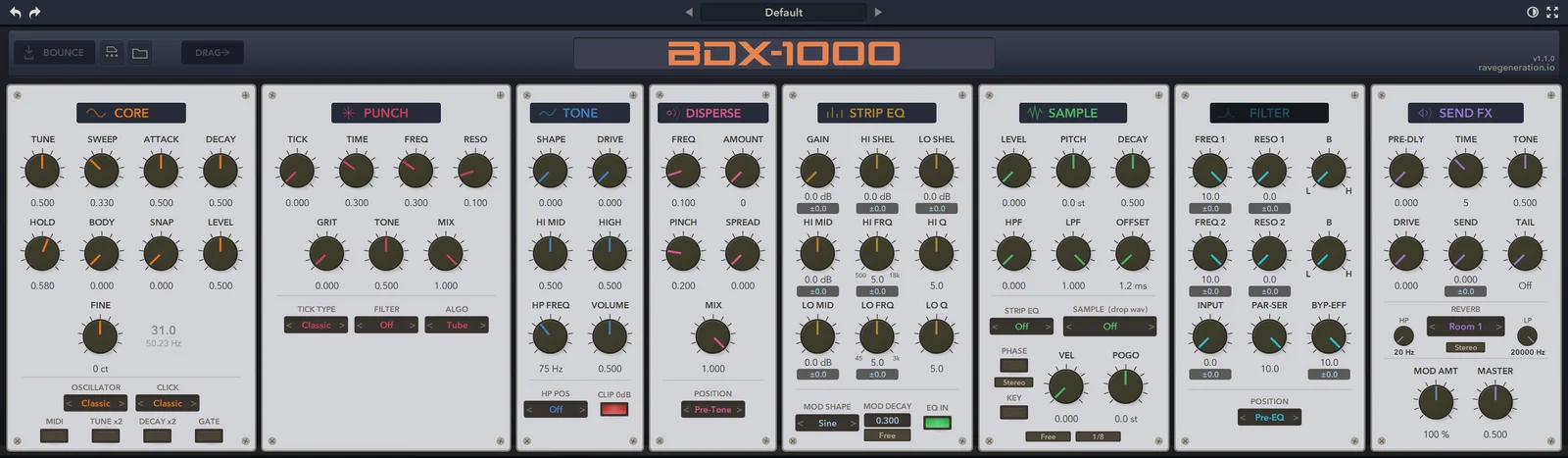
The BDX-909 is another notable instrument. Rather than simply relying on static samples, it provides an approach to kick drum synthesis that allows producers to work directly with the sound, its dynamics, pitch, transient and character. For styles such as Hardcore, Gabber, Techno and other bass-heavy electronic music, having that level of control is particularly relevant.
The VA-1000 also deserves attention. Its combination of analogue-style synthesis, extensive modulation, unison capabilities and integrated effects opens up plenty of creative possibilities, from classic rave stabs and powerful leads to modern bass sounds and atmospheric textures.
Beyond these instruments, the collection covers practically every important area of production: equalisation, dynamics, saturation, distortion, filtering, modulation, stereo imaging, reverb and mastering. This makes the ecosystem interesting not only for individual sound designers but also for producers looking to develop a consistent sonic identity.
What I particularly appreciate about the overall concept is its musical direction. These tools don’t appear to be designed simply to follow current production trends. There is a clear connection to the sound, energy and character of classic electronic dance music, without being limited to nostalgia.
Good sound design is not about having hundreds of plugins. It is about understanding frequencies, harmonics, dynamics, transients and space, and knowing how to use these elements creatively. Tools that give you control over these aspects while encouraging experimentation are always worth exploring.
My overall impression: Rave Generation presents a thoughtfully developed collection of production tools with a clear identity, a strong electronic music focus and a wide range of creative possibilities. It is refreshing to see software development that combines an appreciation for classic hardware and vintage sonic character with the possibilities of modern digital processing.
For producers who enjoy shaping their own sounds rather than simply reaching for ready-made solutions, Rave Generation is certainly a collection worth exploring.